
SEO Localization: Why Translating Keywords Is Not Enough
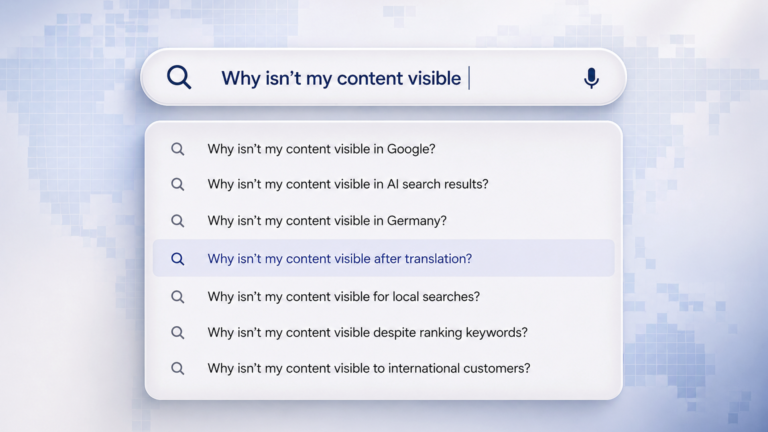
Many companies enter new markets with a simple plan: translate their website, publish localized content, and expect traffic to follow. However, a SEO localization strategy cannot be limited to translating text. If keywords, search intent, and metadata are not adapted to the local market, a page can be well translated and still fail to gain visibility.
In reality, the issue is often simpler.
A page can be well translated and still fail to rank if customers search differently than expected. Visibility depends not only on language, but also on search behavior.
Translation does not equal search visibility
One of the most common mistakes in multilingual marketing is assuming that successful keywords can simply be translated from one language into another.
In practice, users in different regions often search using different terminology, different phrasing, or even entirely different concepts.
For example, a keyword may perform well in the source market, but its direct translation may not reflect how local users actually search. There may be another expression with higher search volume, clearer meaning for the audience, or stronger alignment with user intent. Local keyword research helps identify these differences before publication and adapt content to the real search queries used in each market.
This distinction is where expert SEO localization creates value. Specialists evaluate search data, user intent, and market expectations to identify the language customers actually use, not simply the language businesses prefer.
Four common SEO localization mistakes
1. Translating keywords instead of researching them
A translated keyword is not necessarily a searched keyword.
Before multilingual content is created, local keyword research should be conducted for each target market instead of relying on direct translations of existing keyword lists.
The objective is to understand local demand and search behavior, not to replicate a source-language strategy.
2. Ignoring search intent
People may use similar words while looking for completely different outcomes.
In one market, users may be seeking educational information. In another, they may be comparing suppliers or actively looking to buy. Content that fails to match user intent often underperforms regardless of linguistic quality.
Successful search intent localization requires understanding not only what users search for, but why they search for it.
3. Overlooking metadata
Many organizations localize page content but neglect the elements that influence search visibility:
- Page titles
- Meta descriptions
- Image alt text
- Internal links
- Calls to action
- Structured content elements
These components help search engines understand, categorize, and display content effectively. Localizing only the body text creates an incomplete SEO strategy.
4. Neglecting technical SEO and discoverability
Multilingual SEO depends on more than visible page content. Its technical foundation determines whether search engines can crawl, interpret, and index each language version correctly. URL structure, hreflang tags, indexing settings, page speed, mobile experience, and structured data all influence visibility.
This foundation matters even more as search incorporates AI-driven experiences. Users now ask conversational questions and receive synthesized answers from AI tools, not only traditional search results. To be visible in these environments, content must be clear, easy to understand in context, and aligned with a specific audience, market, and search intent.
Even strong localized content can underperform when technical SEO is not properly managed. In an increasingly complex search environment, technical SEO helps ensure content reaches the right users in the appropriate language and market.
A practical SEO localization framework
Organizations seeking stronger international visibility should focus on four interconnected areas.
Understand local search behavior
Start with market-specific keyword research.
The objective is to discover how potential customers search in each market, not how the business internally describes its products or services.
Adapt content to search intent
Ask what users are trying to achieve.
Are they researching a problem? Comparing alternatives? Evaluating suppliers? Looking to purchase?
Content should be adapted to those expectations rather than simply translated from a source market.
Localize the entire user experience
Effective SEO localization includes more than body content.
Headings, metadata, navigation elements, calls to action, internal links, and supporting content all contribute to visibility and user experience. Search engines evaluate the page as a whole, not individual content blocks in isolation.
Measure performance by market
A multilingual website should never be measured as a single entity.
Search behavior varies significantly across regions and languages. Monitoring each market independently helps organizations identify opportunities, detect performance issues, and refine their international SEO strategy more effectively.
SEO localization now also supports AI visibility
Search is evolving as users increasingly discover information through AI-powered search, conversational interfaces, and generative answer platforms. For multilingual organizations, this makes generative engine optimization part of the visibility challenge: content must be accurately localized, clearly structured, and contextually complete so both search engines and AI systems can understand it across languages and markets.
Poor terminology, inconsistent messaging, or unclear metadata can reduce visibility. Expert-led SEO localization helps ensure multilingual content is translated, discoverable, understandable, and credible across multiple discovery channels.
Before you launch, ask these questions
Before publishing multilingual content, consider:
- Has local keyword research been conducted?
- Are keywords being adapted rather than translated?
- Is local search intent reflected in the content?
- Have metadata and supporting SEO elements been localized?
- Has the technical SEO framework been properly configured?
- Will the content be made clear and understandable across both search engines and AI-powered discovery experiences?
- Has a process been established for measuring results by language and market?
These questions help confirm whether your multilingual SEO strategy is genuinely tailored to how people search, decide, and discover content in each market. When keywords, intent, content, and technical foundations are adapted together, SEO localization becomes more than a translation task. It becomes a practical way to improve visibility across languages, search engines, and AI-powered discovery experiences.