
Medical Translation Errors: Lessons from Real Healthcare Incidents
Healthcare organizations invest heavily in technology, compliance, quality systems, and clinical expertise. Yet one critical risk is often underestimated: language.
Medical translation errors are not only wording problems. In healthcare settings, they can affect how professionals interpret labels, instructions, software documentation, manuals, and patient information. When multilingual medical content is misunderstood or poorly localized, communication problems can become patient safety risks with serious consequences.
This is why medical translation should not be treated as a supporting administrative task. If language affects decisions, it belongs within risk management.
The following healthcare cases illustrate how medical translation errors can compromise patient safety and risk management.
When a product label changes a surgical decision
The Berlin knee prosthesis incident
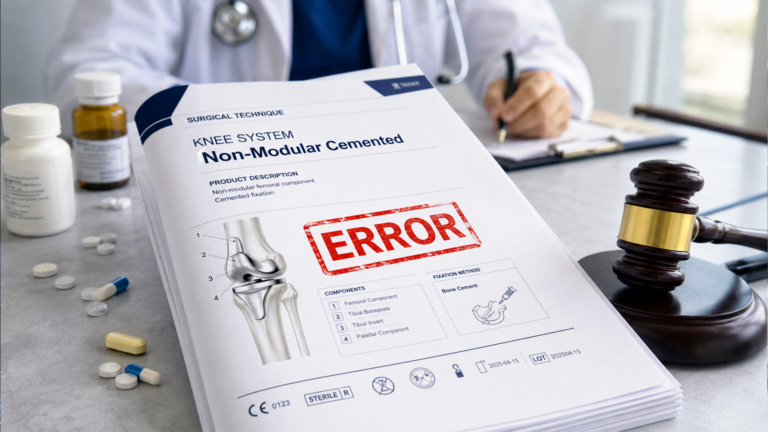
At Sankt Hedwig Hospital in Berlin, 47 patients received knee prostheses that were implanted without bone cement, although the components were intended to be fixed with cement.
The source of the problem was a product label.
The packaging included the English description:
“Non-Modular Cemented”
At first glance, the term appears straightforward. In reality, it describes two separate technical characteristics:
- Non-modular refers to an implant manufactured as a single component rather than assembled from interchangeable parts.
- Cemented means the implant is designed to be fixed using bone cement.
Available reports indicate that the English term was interpreted in German as “zementfrei”, meaning “cement-free” or “without cement”. The confusion appears to have stemmed from the label combining two separate technical ideas: “non-modular” and “cemented”. Here, “non-” applied only to “modular”, meaning the implant was not modular. If read instead as a negation of “cemented”, the product could be mistaken for a cement-free implant, even though it was designed to be fixed with bone cement.
As a result, the implants were inserted without the material required for proper fixation, creating significant patient safety risks.
The incident led to legal proceedings against the hospital and the manufacturer, clinical follow-up for the affected patients, corrective treatments, substantial compensation claims, and significant financial consequences.
This case clearly shows how medical device translation and terminology management can directly affect clinical decisions.
For this reason, healthcare organizations need specialist medical language expertise, not just bilingual staff or generalist translators.
When untranslated documentation contributes to clinical risk
The Épinal radiotherapy accident
The Épinal radiotherapy accident in France is a strong example of how language, documentation, training, software usability, and clinical safeguards can intersect in patient safety.
The case involved patients treated for prostate cancer at Épinal hospital. According to official summaries, a change in the radiotherapy procedure was not properly prepared or controlled, which led to radiation overdosage in 24 patients. French authorities described it at the time as the most serious accident involving ionizing radiation reported in France.
The failure was not caused by language alone. The official investigation pointed to several combined factors, including inadequate preparation for the procedural change, insufficient training, missing safeguards, and software limitations that did not prevent the error.
Documentation also played a role. Operators did not have a French user manual tailored to their daily work. In a high-risk clinical environment, that gap can lead teams to interpret or apply procedures inconsistently. With complex systems, even small differences in how instructions are understood can affect treatment safety.
The lesson for healthcare localization is clear: multilingual medical content must be managed as part of the full safety system, not as a separate final-stage task. Documentation, software interfaces, terminology, workflows, training, and quality assurance all need to work together so that translated and localized content supports safe, consistent use in real clinical settings across languages and markets.
The risk of prioritizing speed over expertise
Healthcare organizations today face immense pressure to accelerate multilingual content production. Product launches are faster, markets are more global, and content volumes continue to grow.
This pressure can push organizations to prioritize speed and cost over specialist expertise, increasing the risk that medical language is treated as ordinary content rather than the highly specialized field it is.
The Berlin and Épinal cases show this in different ways: a brief label can change how a medical device is used, while untranslated or poorly adapted documentation can make complex procedures harder to perform safely.
The same principle applies to emerging technologies.
Artificial intelligence can improve efficiency and support medical translation workflows. It can help manage terminology, draft multilingual medical content, and accelerate review processes. However, fluent output should not be confused with clinically reliable or regulatorily accountable language.
AI does not evaluate clinical risk. It does not assume regulatory responsibility. It does not understand the real-world consequences of ambiguity.
For healthcare organizations, technology is most valuable when combined with very close expert oversight, structured review processes, and clear ownership.
Key lessons for healthcare organizations
These incidents reveal a common pattern: language-related risks were underestimated, even in highly regulated healthcare settings.
Multilingual medical content should not be treated as a compliance formality or final-stage task. It belongs within the same quality and safety framework as devices, software, procedures, training, and clinical workflows.
The Berlin and Épinal cases show that when information is misunderstood, poorly translated, or not properly localized, the consequences go far beyond communication. Language becomes part of the safety infrastructure.
Healthcare organizations cannot eliminate every risk, but they can reduce language-related risk by assigning multilingual medical content to specialist teams, supported by terminology management, expert review, strong quality control, and responsible use of technology.